Sealing Systems and Accessories for String Wound Filter Cartridge Applications
A String Wound Filter Cartridge is widely recognized for its depth filtration performance, but reliable operation also depends heavily on sealing design and accessory selection. In practical installations, improper sealing can lead to bypass, pressure loss, or contamination risks, even when the filtration media itself is well specified. For this reason, gaskets, O-rings, and end seals are critical components that directly influence system integrity.
In many filtration systems, a String Wound Sediment Filter Cartridge is installed as a pre-filtration element, where stable sealing ensures that all process fluid passes through the wound media as intended. Over time, consistent sealing performance also becomes a key factor during String Wound Filter Cartridge Replacement, helping operators maintain predictable filtration results without modifying housings or piping.
Role of Sealing Components in Cartridge Filtration
Sealing components serve as the interface between the cartridge and the filter housing. Their primary function is to prevent unfiltered liquid from bypassing the media, which would reduce filtration efficiency and compromise downstream equipment protection. In a String Wound Filter Cartridge system, seals must accommodate axial compression, pressure fluctuations, and repeated installation cycles.
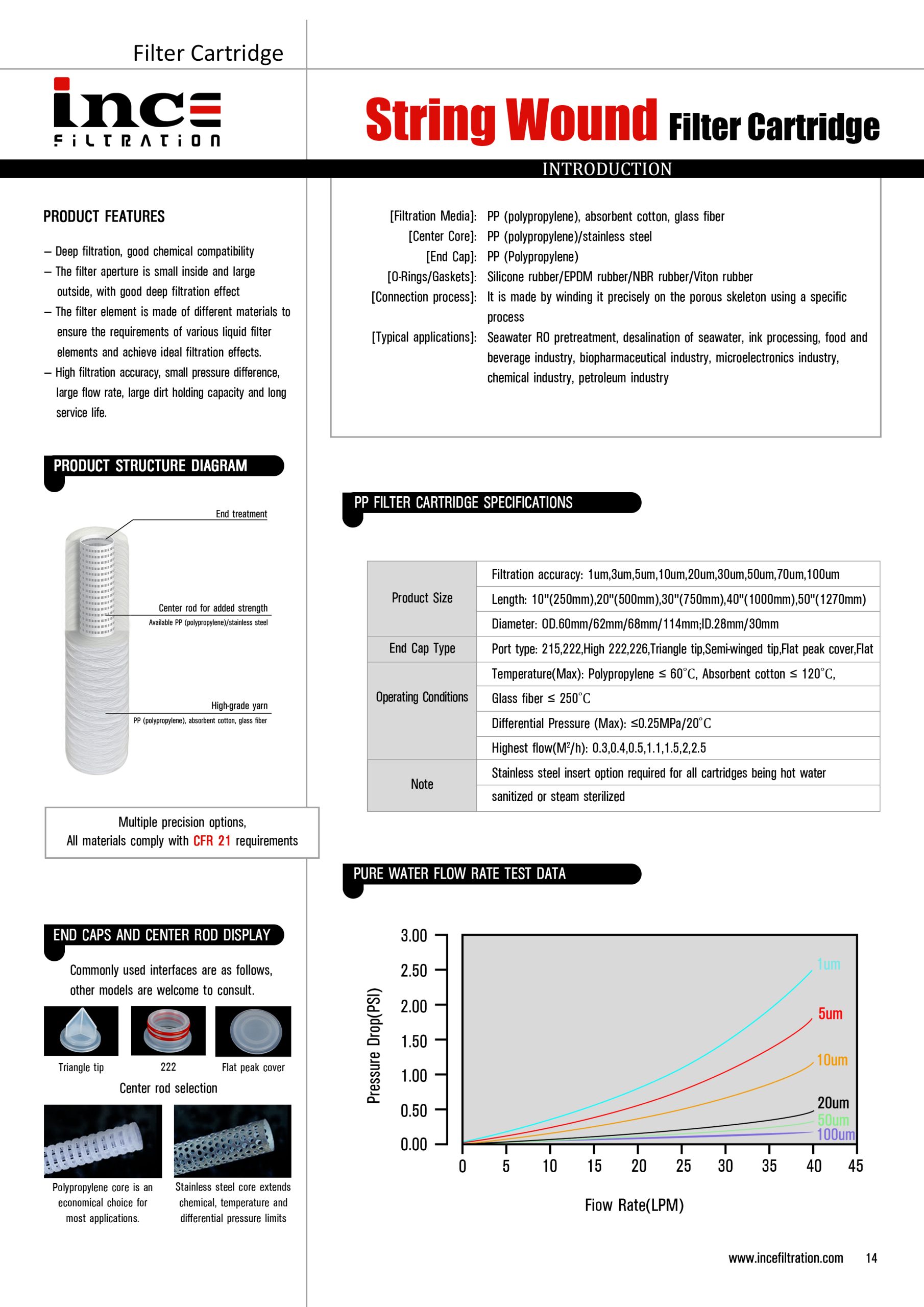
Different housing designs require different sealing approaches, including flat gaskets, molded end caps, or elastomeric O-rings. The effectiveness of these components depends on material elasticity, chemical compatibility, and dimensional accuracy. When seals are correctly matched to the cartridge and housing, pressure stability and flow consistency are significantly improved.
During operation, sealing materials are exposed to process fluids, temperature changes, and mechanical stress. Selecting appropriate sealing accessories helps extend service life and reduces the risk of leakage or seal deformation, particularly in continuous-duty filtration systems.
Common Gasket and O-Ring Material Options
A string wound filter cartridge with EPDM gasket is commonly used in water treatment and general industrial applications. EPDM offers good resistance to water, steam, and many mild chemicals, making it suitable for systems where temperature stability and long-term elasticity are required.
For applications that demand flexibility across a wide temperature range, a string wound filter cartridge silicone o-ring is often specified. Silicone maintains its sealing properties under both low and moderately high temperatures, supporting reliable performance in systems with frequent thermal variation or cleaning cycles.
In more chemically aggressive environments, a string wound filter cartridge Viton seal provides enhanced resistance to oils, solvents, and certain acids. Viton seals are typically selected for chemical processing or oil-related applications where standard elastomers may degrade prematurely.
A string wound filter cartridge NBR gasket is another widely used option, particularly in oil and fuel filtration systems. NBR, also known as nitrile rubber, offers good resistance to hydrocarbons and provides effective sealing in applications involving lubricants, fuels, or oily process fluids.
Sealing Consistency and Replacement Considerations
Maintaining sealing consistency is especially important during String Wound Filter Cartridge Replacement. Using replacement cartridges with different gasket or O-ring materials than the original specification can alter compression behavior and lead to leakage or bypass. Matching seal material, hardness, and geometry helps ensure that performance remains consistent after each change-out.
In systems that undergo frequent maintenance, seal durability becomes a deciding factor. Elastomers that resist compression set and chemical degradation help reduce the need for unplanned shutdowns. A well-matched String Wound Sediment Filter Cartridge with appropriate sealing accessories supports stable filtration performance over multiple service cycles.
From a procurement and maintenance perspective, documenting seal specifications alongside cartridge dimensions simplifies inventory management. This approach allows maintenance teams to replace cartridges efficiently while maintaining confidence that sealing integrity will not be compromised.
Selection Guidance for Engineers and Operators
When selecting sealing options for a String Wound Filter Cartridge, system conditions should guide decision-making. Key factors include operating temperature, chemical exposure, pressure range, and cleaning procedures. Evaluating these parameters helps determine whether EPDM, silicone, Viton, or NBR sealing materials are most appropriate.
Compatibility between the cartridge, seal, and housing is equally important. Even high-quality sealing materials can fail if dimensional tolerances are inconsistent. Choosing cartridges manufactured with controlled sealing interfaces reduces installation variability and supports predictable system behavior.
By aligning sealing materials and accessories with application requirements, operators can enhance filtration reliability, reduce leakage risks, and streamline maintenance planning. Properly specified seals transform a String Wound Filter Cartridge from a simple filtration element into a dependable component within a well-managed filtration system.
Related Products