
Polypropylene Felt Filter Bag vs Nylon Mesh Filter: Choosing the Right Solution for Liquid Filtration
In industrial liquid filtration, selecting the right filter media directly impacts process stability, product quality, and operational cost. As filtration requirements become more specific, users often face a common question: should they choose a polypropylene felt filter bag or a nylon mesh filter? Each option offers distinct advantages, but differences in structure, filtration mechanism, and application suitability can significantly influence performance. Understanding these differences helps users make more informed decisions based on their actual operating conditions.
Product Design and Filtration Mechanism
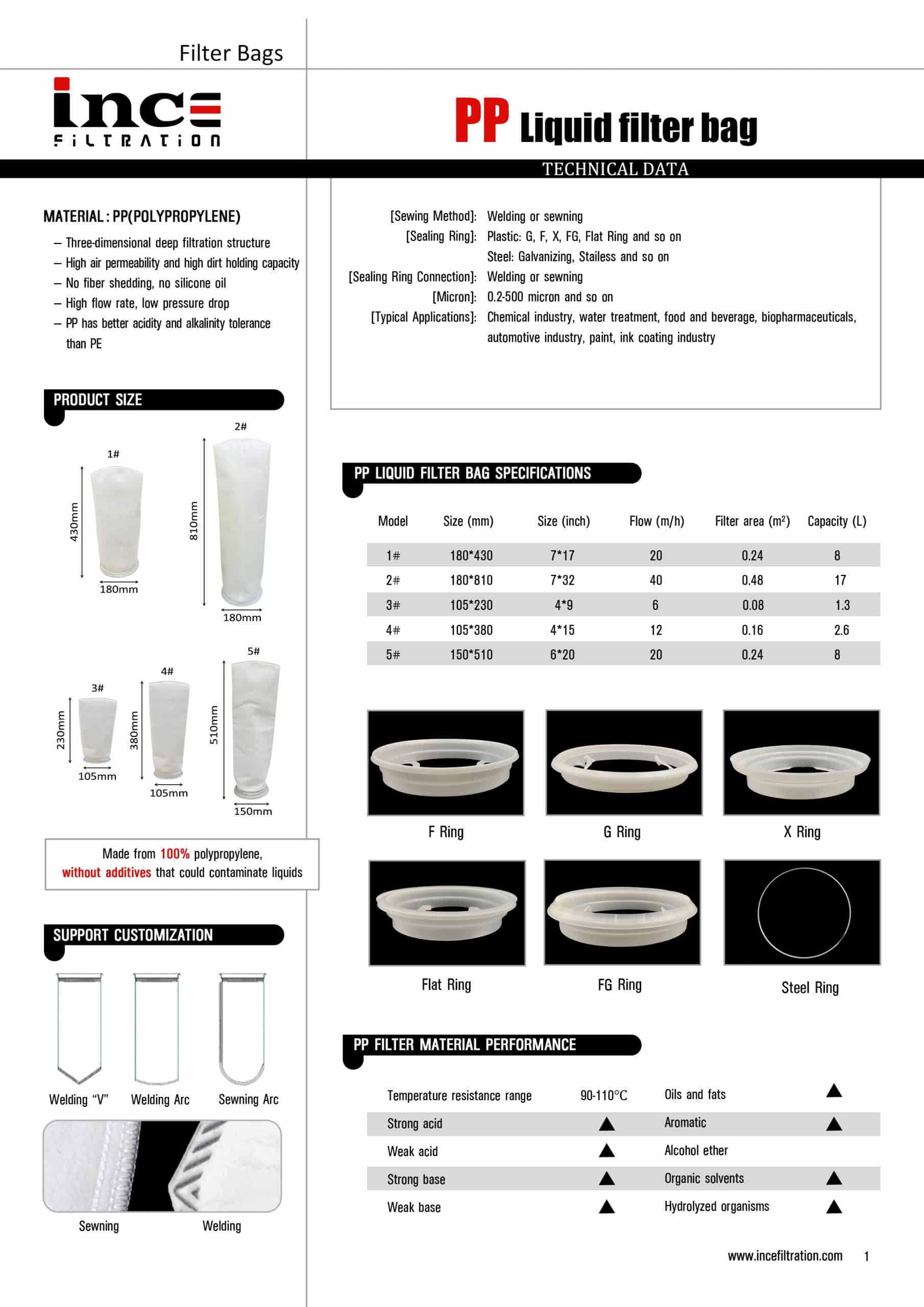
A polypropylene felt filter bag is manufactured using needle-punched polypropylene fibers, forming a thick, depth-type filtration medium. This structure allows particles to be captured throughout the entire material, rather than only on the surface. As a result, it can retain a higher volume of contaminants while maintaining stable flow performance.
In contrast, a nylon mesh filter uses woven monofilament fibers to create a precise, uniform opening size. This design supports surface filtration, where particles larger than the mesh openings are captured on the surface. Unlike a polypropylene felt filter bag, the nylon mesh filter does not provide depth retention, which limits its dirt-holding capacity but allows for highly consistent particle size control.
Material properties also differ. The polypropylene felt filter bag offers strong resistance to a wide range of acids and alkalis, while nylon mesh filters generally provide better mechanical strength and abrasion resistance. These differences play a key role in determining which filter is more suitable for a given process.
Key Performance Differences
One of the main advantages of a polypropylene felt filter bag is its high dirt-holding capacity. The depth filtration structure enables it to capture and retain a large amount of particles before requiring replacement. This results in longer service life and reduced maintenance frequency.
On the other hand, a nylon mesh filter excels in applications where precise and repeatable filtration accuracy is required. Because of its fixed pore size, it delivers consistent particle separation. However, compared with a polypropylene felt filter bag, it tends to clog faster when handling fluids with high contaminant loads.
Flow stability is another important factor. A polypropylene felt filter bag maintains relatively stable flow rates as contaminants are distributed throughout the media. In contrast, nylon mesh filters may experience a more rapid increase in pressure drop as particles accumulate on the surface.
Chemical compatibility also varies. The polypropylene felt filter bag performs reliably in many corrosive environments, while nylon mesh filters are better suited for neutral or less aggressive liquids. Selecting the appropriate material is essential to ensure long-term performance and avoid premature degradation.
Suitable Application Scenarios
The polypropylene felt filter bag is widely used in applications where high particle load and depth filtration are required. In water treatment systems, it is effective for removing suspended solids and protecting downstream equipment. In chemical processing, it performs well when filtering corrosive liquids and complex mixtures.
In contrast, nylon mesh filters are commonly used in applications where particle size uniformity is critical. For example, they are suitable for screening applications, coating processes, and situations where reusable filtration is preferred. While a polypropylene felt filter bag is typically designed for single-use or limited reuse, nylon mesh filters can often be cleaned and reused multiple times.
For food and beverage processes, both options may be used depending on the stage of filtration. A polypropylene felt filter bag is often selected for bulk filtration or clarification, while nylon mesh filters are used for final screening or particle size control.
Operational and Economic Considerations
From an operational standpoint, a polypropylene felt filter bag offers advantages in reducing downtime. Its higher dirt-holding capacity means fewer changeouts, which is beneficial for continuous production environments. This can help lower labor costs and improve overall process efficiency.
Nylon mesh filters, while requiring more frequent cleaning, can offer cost savings in applications where reuse is practical. However, cleaning procedures must be properly managed to maintain filtration accuracy. Compared with a polypropylene felt filter bag, the operational cost advantage depends heavily on the specific application and maintenance practices.
In terms of system protection, a polypropylene felt filter bag provides more comprehensive particle removal in high-load conditions, helping extend the life of downstream equipment. Nylon mesh filters, due to their surface filtration nature, are better suited for lighter loads and controlled filtration environments.
Selection and Customization Considerations
Choosing between a polypropylene felt filter bag and a nylon mesh filter depends on several factors, including particle size, contaminant load, chemical compatibility, and maintenance preferences. For applications requiring high capacity and broad chemical resistance, a polypropylene felt filter bag is often the preferred solution.
Customization options are available for both types. A polypropylene felt filter bag can be produced in various micron ratings, sizes, and sealing configurations to match different filter housings. Nylon mesh filters also offer different mesh sizes and construction options to meet specific filtration requirements.
Consistent manufacturing quality is essential for both filtration types. A well-produced polypropylene felt filter bag ensures uniform fiber distribution and reliable performance, while a high-quality nylon mesh filter provides accurate and repeatable pore size control.
Closing Paragraph
Both the polypropylene felt filter bag and nylon mesh filter serve important roles in industrial filtration systems. While the former offers depth filtration, high dirt-holding capacity, and strong chemical resistance, the latter provides precise surface filtration and reusability. Selecting the appropriate solution depends on process requirements, operating conditions, and long-term performance expectations.