
High-Performance Liquid Filter Bags for Reliable Industrial Purification
The efficiency of industrial liquid processing systems often hinges on the selection of appropriate filtration media. In sectors ranging from automotive coating to wastewater treatment, the ability to remove solid contaminants from process streams is essential for maintaining product consistency and protecting downstream equipment. Many plant operators face significant challenges related to premature media failure, bypass issues, and the high cost of frequent filter change-outs. These problems are often exacerbated by aggressive chemical environments or varying particulate loads that standard filtration solutions struggle to manage effectively. When a filtration system underperforms, it leads to increased production downtime and potential damage to high-value assets, creating a ripple effect of operational inefficiency.
To address these concerns, engineers frequently turn to depth-loading media that offers a balance of high dirt-holding capacity and chemical compatibility. By integrating a polypropylene felt filter bag into the process, facilities can achieve a more robust separation of solids from liquids. This specific type of filtration hardware is designed to handle a wide range of flow rates while providing a reliable barrier against contaminants of various sizes. Choosing the right bag involves more than simply matching a micron rating; it requires a deep understanding of material science and how different manufacturing techniques impact the overall performance and reliability of the filtration stage in a heavy-duty industrial environment.
Material Science and Construction of Needle Felt Media
The structural integrity of a polypropylene felt filter bag is derived from a specialized manufacturing process known as needle punching. This technique involves mechanically interlocking thousands of synthetic fibers to create a dense, three-dimensional matrix. Unlike woven mesh materials that rely on a two-dimensional grid, the needle felt structure provides a “tortuous path” for the fluid. As the liquid passes through this matrix, particles are trapped not only on the surface but throughout the entire depth of the material. This characteristic allows for a significantly higher volume of solids to be retained before the pressure differential reaches a point where a change-out is required.
Furthermore, the structure of a polypropylene felt filter bag is designed to maintain its pore size even under fluctuating pressure conditions. The inherent elasticity and strength of polypropylene fibers allow the media to resist compression, which is a common cause of efficiency loss in lower-quality filtration products. During the final stages of production, the external surface of the felt is often subjected to a singeing or glazing process. This thermal treatment melts the outermost fibers together, effectively creating a smooth finish that prevents fiber migration into the filtrate. This feature is particularly critical in applications like paint and ink production, where loose fibers could cause catastrophic defects in the final finish.
Manufacturing a polypropylene felt filter bag also involves advanced sealing techniques to eliminate the risk of bypass. While traditional bags were often sewn together, modern industrial standards favor fully welded construction. In a welded bag, the seams and the collar are fused using ultrasonic or thermal energy, creating a bond that is as strong as the media itself. This eliminates the needle holes associated with sewing, which can often be a source of particulate bypass. The result is a seamless filtration component that ensures all fluid must pass through the interlocking fiber matrix, providing consistent effluent quality across the entire production cycle.
Performance Advantages and Technical Resilience
One of the primary benefits of using a polypropylene felt filter bag is its exceptional chemical resistance. Polypropylene is a highly inert polymer, making it suitable for filtering a vast array of acids, alkalis, and organic solvents that would degrade other materials like polyester or nylon. This chemical stability ensures that the filter media does not swell, soften, or lose its tensile strength when exposed to aggressive process fluids. For facilities handling diverse chemical streams, this versatility simplifies inventory management and reduces the risk of using an incompatible filter material that could fail prematurely and contaminate the system.
In addition to chemical resilience, the depth-loading nature of the media provides a superior dirt-holding capacity. When comparing surface filtration to the performance of a polypropylene felt filter bag, the latter typically offers a much longer service life. Because the particulates are distributed through the depth of the felt, the filter does not “blind” as quickly as a screen or mesh. This allows for a more linear increase in pressure drop over time, giving operators more predictability in their maintenance schedules. A stable pressure profile also reduces the energy demand on the pumping system, as the pump does not have to overcome a rapidly increasing resistance during the mid-cycle phase of the filtration process.
| Chemical Agent | Compatibility Rating | Notes |
| Weak Acids | Excellent | Resistant to most organic and inorganic acids |
| Strong Acids | Excellent | Highly stable in hydrochloric and sulfuric acids |
| Weak Alkalis | Excellent | Resistant to sodium bicarbonate and similar salts |
| Strong Alkalis | Excellent | Maintains integrity in high-pH environments |
| Solvents | Good to Fair | Resistant to many alcohols; check for specific hydrocarbons |
| Oxidizing Agents | Fair | Avoid high concentrations of strong oxidizers |
To ensure the polypropylene felt filter bag prevents fiber migration, high-quality units undergo a rigorous “heat-set” process. This treatment stabilizes the fiber matrix and ensures that the micron rating remains accurate throughout the duration of use. Unlike some depth media that may “unload” captured particles as the pressure differential increases, the interlocked structure of needle felt provides a secure trap for solids. This reliability is essential in high-stakes environments like the electronics industry or pharmaceutical pre-filtration, where even a minor release of captured contaminants or filter fibers could lead to significant downstream processing issues.
Versatility in Industrial Application Scenarios
The versatility of a polypropylene felt filter bag allows for its implementation in a wide variety of industrial sectors where fluid clarity is a priority. In the automotive industry, these bags are used extensively in the filtration of e-coat paints, primers, and clear coats. The ability to remove tiny craters-forming particles and silicone contaminants without shedding fibers makes them indispensable for achieving the high-gloss finishes required in modern vehicle manufacturing. The bags are typically placed in high-flow housings that can accommodate multiple units, ensuring that the painting line can operate continuously without interruption.
In the chemical manufacturing sector, the demand for high-purity intermediates and final products necessitates reliable separation technology. Installing a polypropylene felt filter bag in the production line for resins, polymers, and specialty chemicals helps to ensure that no undissolved solids or external contaminants reach the packaging stage. Because these bags can be manufactured to meet specific micron ratings—ranging from 1 to 200 microns—they provide the flexibility needed to handle different viscosity fluids and particle size distributions. This adaptability is key for batch processes where the filtration requirements may change depending on the specific product being manufactured.
Water treatment and environmental protection also benefit from this filtration technology. Whether used for filtering cooling tower water, process water, or treated wastewater before discharge, a polypropylene felt filter bag provides a cost-effective way to meet environmental regulations and protect municipal sewer systems. In these applications, the bags often serve as a pre-filtration stage to remove bulk solids, sand, and scale before the water moves to more delicate systems like ultraviolet (UV) sterilizers or carbon beds. By taking the brunt of the particulate load, the felt bags extend the life of more expensive components and reduce the overall maintenance burden on the facility’s water management team.
Operational Economics and System Efficiency
From a business perspective, the use of a polypropylene felt filter bag offers a compelling economic argument centered on the concept of cost-per-gallon efficiency. While the initial price of a filter bag is generally low compared to complex cartridge systems, the real value lies in its high capacity and ease of use. A high-quality polypropylene felt filter bag lowers cost-per-liter by extending the intervals between change-outs and reducing the amount of waste generated. In high-volume operations, the cumulative savings in both hardware costs and disposal fees can be substantial over a single fiscal year.
Labor efficiency is another critical factor in the economic equation. Changing out a filter bag is a relatively simple and fast process compared to cleaning fixed-media filters or replacing multi-element cartridge housings. The “top-entry” or “side-entry” design of most bag filter housings allows for quick access, and the lightweight nature of the bags makes them easy for a single operator to handle. By minimizing the time required for maintenance, the facility can maximize its uptime and focus its human resources on more complex production tasks. This “ease-of-use” factor also reduces the likelihood of installation errors that could lead to bypass or system damage.
Technical Note: When evaluating the total cost of ownership, operators should consider not just the unit price of the bag, but the terminal pressure drop at which they perform a change-out. A bag that can hold 50% more dirt than a competitor’s product is effectively twice as valuable, even if its initial price is slightly higher, because it halves the labor cost and production downtime associated with maintenance.
Furthermore, the efficiency of a polypropylene felt filter bag reduces waste by maximizing the utility of every gram of media. Because the entire volume of the needle felt is used for particle storage, the weight of the discarded bag relative to the amount of contaminant removed is very low. This is an important consideration for companies operating under strict sustainability mandates or those looking to minimize their environmental footprint. By choosing a filter that performs longer and more effectively, organizations can demonstrate a commitment to lean manufacturing principles while simultaneously improving their operational profitability.
Quality Assurance and Customization Requirements
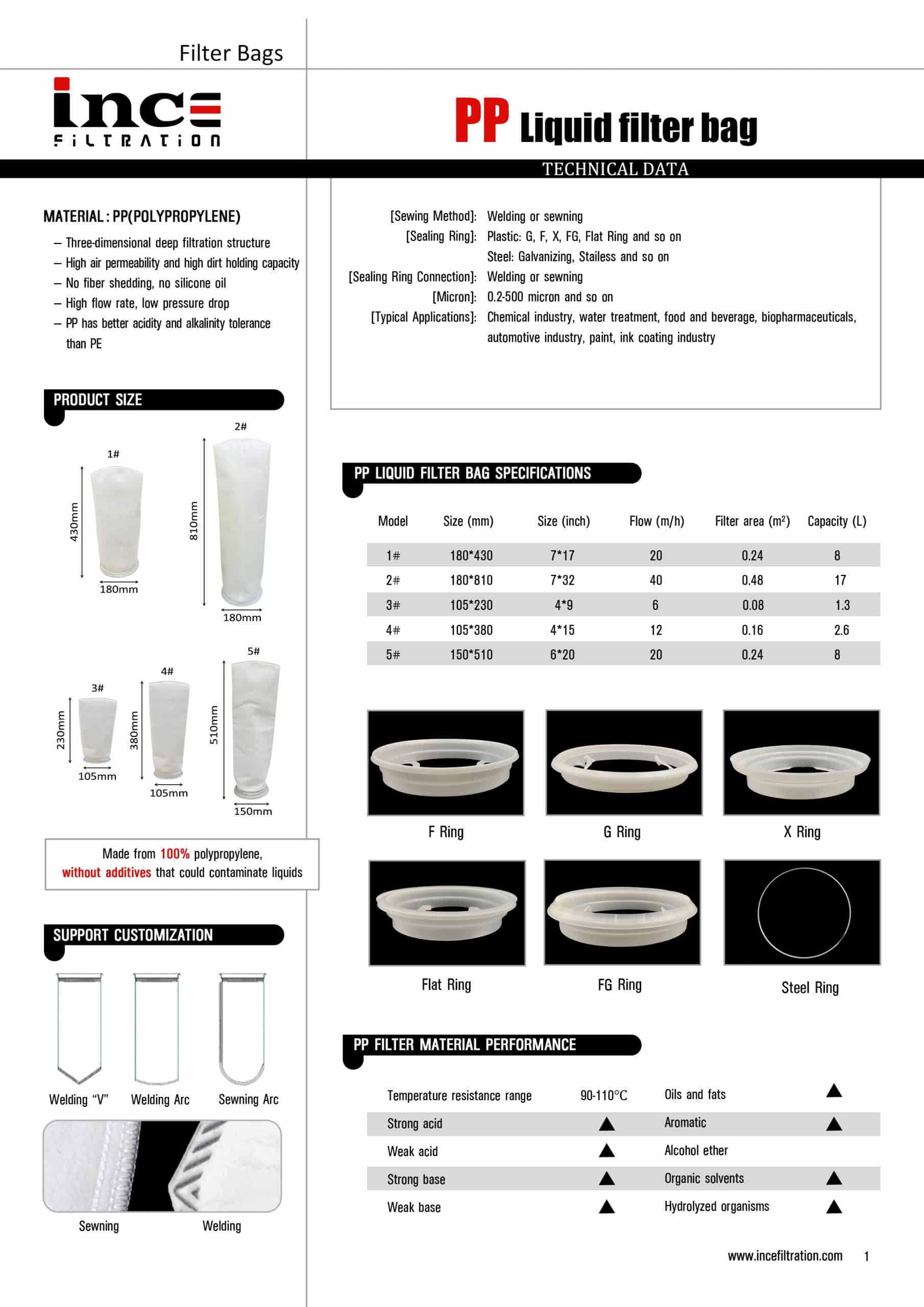
To meet the rigorous demands of global industry, customizing a polypropylene felt filter bag with plastic collars or specialized ring seals is often necessary. The seal at the top of the bag is the most critical point of the entire filtration system; if it fails, the entire filtration process is compromised by bypass. Most modern industrial bags utilize a plastic “V” or “SDS” style ring that creates a pressure-activated seal against the housing wall. This design ensures that as the internal pressure of the bag increases, the seal becomes tighter, preventing any liquid from circumventing the media. These rings are typically molded from the same polypropylene material as the bag to ensure total chemical compatibility.
Quality control is paramount in the production of these filtration components. Every polypropylene felt filter bag undergoes testing to verify its micron retention efficiency and its structural strength under load. This includes checking the consistency of the needle felt density and ensuring that all welded seams are uniform and free from defects. For specialized industries like the food and beverage or pharmaceutical sectors, manufacturers often provide bags that are produced in cleanroom environments and are compliant with FDA or EU regulations for food contact. This level of quality assurance gives procurement managers the confidence that the products they receive will meet the safety and performance standards of their specific industry.
Beyond the seal and the media, the physical dimensions of the bag can be tailored to fit a variety of standard and custom housings. While the “Size 1” and “Size 2” bags are the most common in the industry, custom lengths and diameters can be produced to solve specific space constraints or flow requirements. Additionally, features like pull tabs for easier removal or reinforced handles can be added to improve the ergonomics of the maintenance process. This flexibility ensures that the filtration system can be optimized for the specific needs of the facility, providing the best possible balance of flow rate, particle retention, and operational convenience.
Choosing a polypropylene felt filter bag ensures that a facility is equipped with a reliable and versatile tool for liquid purification. The combination of needle-punched depth media, welded construction, and high chemical resistance creates a filtration solution that can withstand the rigors of heavy industrial use while delivering consistent results. By focusing on high-quality materials and precision manufacturing, companies can protect their equipment, maintain their product standards, and achieve long-term operational success in an increasingly competitive global market.